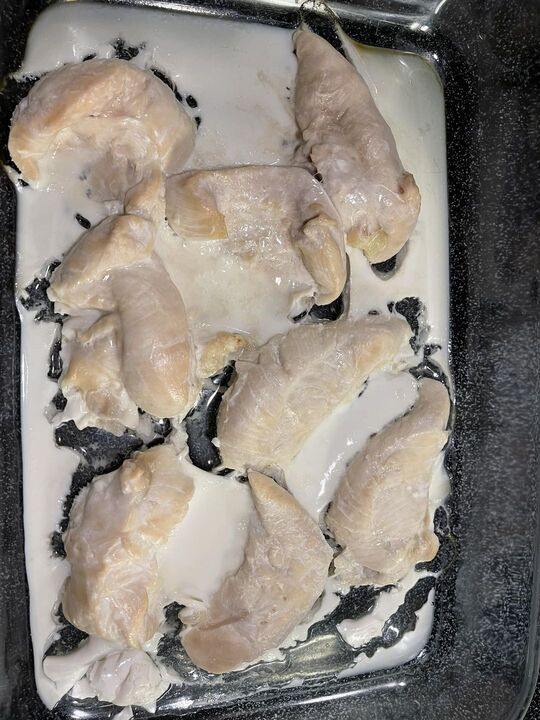
If you’ve ever cooked a chicken and noticed that it’s purging a white jelly-like substance, don’t worry! The gross goo may look unappetizing, but it’s actually a natural phenomenon caused by protein escaping the bird as it cooks.
You pull your perfectly seasoned chicken breast out of the oven, and there it is – a strange, oozing white goo. You wanted a juicy, golden-brown masterpiece, but now your chicken looks like it’s melting.
But don’t worry, this poultry predicament happens to chicken lovers everywhere, from casual home cooks to professional chefs, according to personal chef, Drew Curlett.
“It might not be pretty, but it’s pretty normal to see white stuff come out of chicken, especially when baked or roasted,” the culinary instructor tells Reader’s Digest.
What is the goop?
Despite its strange appearance, the white stuff oozing from chicken isn’t anything to panic about. It’s a combination of protein and water that coagulates when the chicken is cooked at high temperatures.
Chicken meat, especially the breast, is rich in protein, and when you cook it, the heat causes the protein to transform or “denature” – the same way an egg white turns solid white when cooked. This process forces water out of the meat, and as the proteins clump together, they create that white, slightly sticky, semi-solid goo you see on the surface.
This phenomenon is most common when you:
Cook boneless, skinless chicken breasts (since they contain less fat and more protein). “It’s really common when cooking at high heat without much in the way of liquid or fat, like if you’re baking plain, boneless, skinless chicken breasts,” Curlett said.
Use high heat methods like roasting, baking, or pan-searing. Cooking chicken at too high of a temperature too quickly can cause proteins to rapidly contract, forcing out more liquid and forming that gooey layer.
The best way to minimize this effect is by using medium heat and allowing the chicken to rest after cooking. Resting helps redistribute the juices back into the meat rather than letting them leak out immediately.
Cook frozen chicken that hasn’t been fully thawed (the excess moisture contributes to the effect). This happens because freezing causes ice crystals to form within the muscle fibers, damaging their structure. When thawed, the broken-down fibers release more moisture and proteins during cooking, increasing the likelihood of seeing the white substance.
Is white goo safe to eat?
While it might look unappetizing, this white substance is perfectly safe to eat. It’s just cooked protein and water – completely edible and doesn’t affect the taste of your chicken.
However, if your chicken has an odd smell, slimy texture, or discoloration before cooking, that’s a sign of spoilage. The white substance itself is harmless, but if your chicken has other signs of going bad, it’s best to discard it.
Reduce the goop
If you’d rather not have your chicken oozing out the goo, there are ways to reduce its appearance.
Cook at a lower temperatures: High heat speeds up the coagulation process, making the white goo more noticeable. Try baking at 350°F (175°C) instead of 400°F (205°C) for a more gradual cook.
Brine your chicken: Soak your chicken in a simple saltwater solution for 30 minutes to an hour helps retain moisture and reduces the amount of protein loss during cooking.
Sear before baking: Searing the chicken in a hot pan before transferring it to the oven locks in juices and can minimize the white protein leakage.
Let the chicken rest: Cooking cold chicken straight from the fridge (or worse, partially frozen chicken) increases the amount of white stuff that appears. Let it sit at room temperature for 15–20 minutes before cooking.
Use premium chicken: Factory-farmed chicken tends to contain more water due to processing, making the white goo more pronounced. If possible, opt for organic or air-chilled chicken, which contains less excess moisture.
Just remember you can minimize it, but unless you’re cooking low and slow, some protein leakage is natural.
The white stuff coming out of your chicken is just protein and water reacting to heat and it’s totally natural and safe to eat. While it may not be the prettiest sight, it doesn’t affect the taste or safety of your meal.
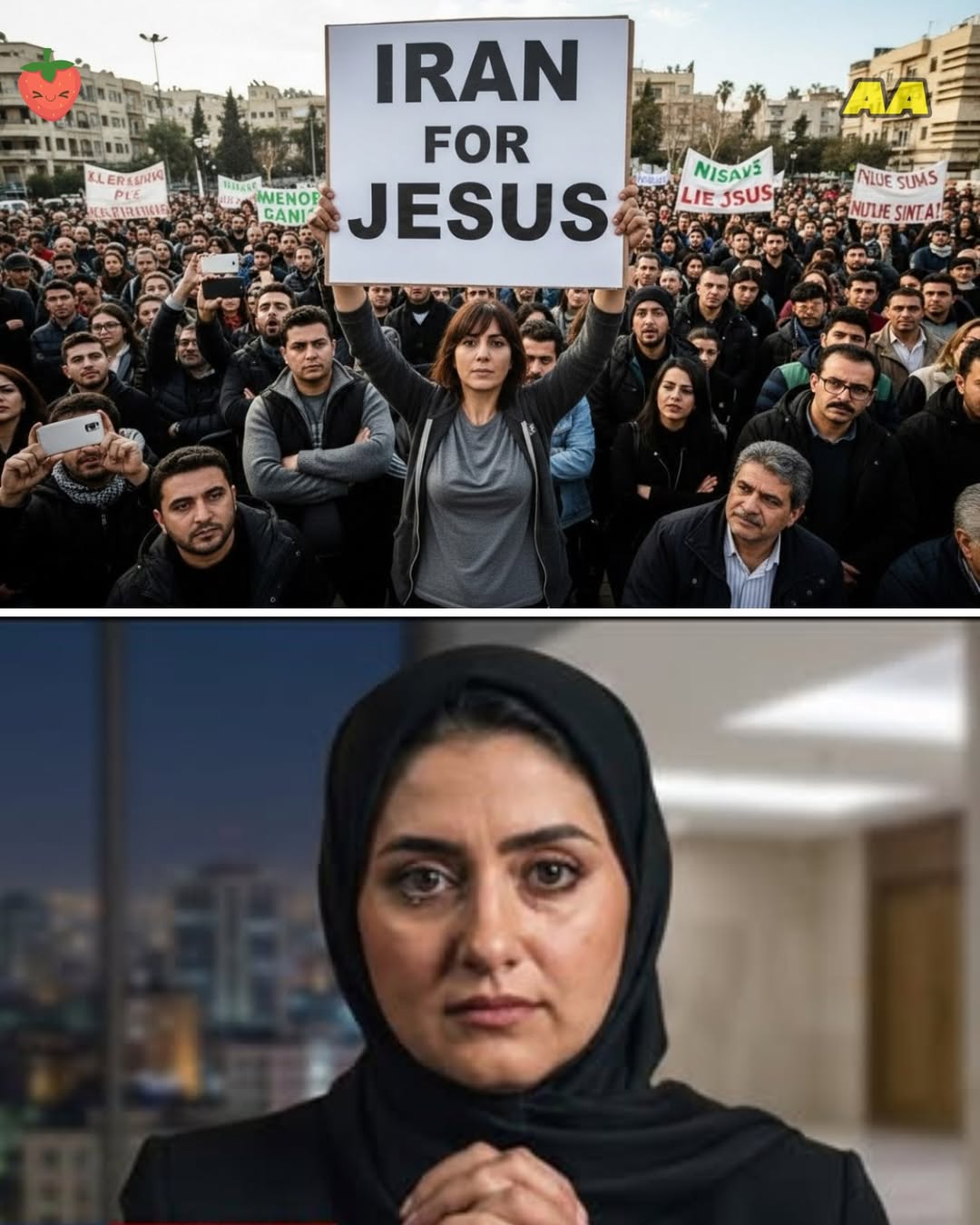
Imagine growing up behind the walls of Iran’s most feared regime where your father works for the supreme leader.
You are known popularly as the adopted daughter of the supreme leader and your future is secured by power and silence.
But everything changed when she met Jesus.
For 23 years, I was the perfect Muslim daughter until the man in white walked into my locked bedroom at 3:00 a.m.
and spoke my name.
Today, my face is known nationwide.
I have lost my family, my citizenship, and my safety.
But I am telling a story the Iranian government is terrified you will hear.
From the palace in Thran to a lonely apartment in exile, this is the viral testimony of a woman who lost everything to find the one thing that matters.
Jesus Christ is appearing in Iran right now and he is shaking the foundations of the Islamic Republic.
My name is Nazanin Moubaser.
I am 23 years old and I was born in Thran, Iran on a cold winter morning in January 2002.
My father, Ahmed Moubaser, serves as a senior adviser to the Supreme Leader Office in K.
My mother Fatim comes from a family of religious scholars who have served the Islamic Republic since the revolution in 1979.
I have two older brothers, Hussein and Javad, both working in the Revolutionary Guard Intelligence Division, and one younger sister, Miam, who is 18 and studying Islamic Jewish prudence at Alzah University.
We are not the immediate family of the Supreme Leader, but we are close enough that our name carries weight in the corridors of power.
Close enough that security guards recognize our car.
close enough that we live behind walls that separate us from ordinary Iranians.
I grew up in a large compound in the Farmania district of northern Thyan near the foothills of the Albor’s mountains.
Our home sits on 2 acres of land surrounded by high concrete walls topped with security cameras.
There are guards at the gate 24 hours a day checking identification, monitoring who comes in and who goes out.
Inside the compound, there are three separate buildings.
The main house where my parents live, a smaller house where my grandmother lives, and a guest house used for important visitors from com or foreign delegations.
The garden is beautiful, full of pomegranate trees, rose bushes, and a fountain in the center that runs all year.
But the beauty cannot hide what it really is.
A cage, a gilded, comfortable, prestigious cage, but a cage nonetheless.
My childhood was not like the childhood of most Iranian girls.
I did not play in the streets.
I did not go to public school.
I did not have friends from the neighborhood.
Everything in my life was controlled, monitored and arranged by my family.
I had private tutors who came to the house to teach me Farsy literature, mathematics, science and English.
I had a religious instructor, a strict woman named Kanum Amadi who taught me Quranic recitation, Islamic history and the principles of Shia Islam.
From the time I was 6 years old, I wore hijab inside the house whenever men outside the immediate family were present.
By the time I was nine, I wore full chador whenever I left the compound.
Modesty, obedience, and devotion to Islam were drilled into me every single day.
My father is a quiet man, but his silence carries more weight than most people’s words.
He rarely speaks to me directly.
In our culture, fathers and daughters do not have casual conversations.
He speaks to my brothers about politics, about strategy, about the enemies of the Islamic Republic.
He speaks to my mother about household matters and family reputation.
But to me, he says very little.
I learned early that his silence was approval and his attention was correction.
So I stayed quiet, obedient, and invisible.
My mother on the other hand is constantly present.
She manages the house, organizes religious gatherings for women and ensures that our family’s reputation remains spotless.
She loves me in her own way, but her love is expressed through control.
She chooses my clothes, monitors my phone, decides who I can spend time with, and reminds me constantly that I represent the family and must never bring shame.
The rhythm of my life was built entirely around Islamic practice.
Every day began before dawn with the call to prayer echoing from the nearby mosque.
I would get up, perform woodoo in the cold bathroom, washing my hands, face, arms, and feet and then join my mother and grandmother in the small prayer room we have in the house.
We would spread our prayer rugs facing Mecca and go through the motions of fajar prayer, bowing, prostrating, reciting verses from the Quran in Arabic that I had memorized but did not always understand.
After prayer, my grandmother would sit with me and make me recite Quranic passages from memory.
She had a wooden cane that she would tap on the floor whenever I made a mistake.
I memorized surah al bakar, surah al Imran, surah Mariam and dozens of others.
The words became part of my breathing, part of my daily existence, but they never touched my heart.
After breakfast, I would spend the morning studying with my tutors or attending online university lectures.
My father decided I would study political science, though I had no interest in politics.
But interest did not matter.
What mattered was that I studied something appropriate for a woman of my position, something that would make me useful in managing a household or supporting a future husband’s career.
I attended my classes on my laptop in my bedroom.
Camera off, microphone muted unless I had to answer a question.
I barely interacted with other students.
My world was incredibly small.
Afternoons were my own mostly.
I would read, browse the internet under my mother’s supervision or spend a time in the garden.
But even in those quiet moments, I felt a weight pressing down on my chest.
A heaviness I could not name.
I prayed five times a day, every single day without fail.
Fajar before dawn, der at noon, assur in the afternoon, Mghreb at sunset and isha at night.
I fasted during Ramadan.
I gave charity.
I attended women’s religious lectures at the mosque.
I wore my chador properly.
I lowered my gaze around men.
I obeyed my parents.
I honored the supreme leader.
I did everything a good Muslim girl from a religious family was supposed to do.
But inside, I felt absolutely nothing.
Prayer felt like checking boxes on a list.
Fasting felt like enduring a hunger.
Quranic recitation felt like repeating words in a language that did not speak to my soul.
I went through all the motions perfectly.
But my heart was somewhere else.
Somewhere I could not reach.
I thought maybe this was normal.
Maybe everyone felt this way.
Maybe faith was not supposed to feel like anything.
Maybe it was just obedience, just duty, just performance.
So I kept going.
I kept pretending.
6 months ago, my father told me during a dinner that I was engaged.
He did not ask my opinion.
He simply announced it.
My future husband was a man named Reza Karimi, a 34year-old official in the Ministry of Intelligence and Security.
I had met him twice at family gatherings.
He was serious, cold, and barely looked at me when we were in the same room.
My father explained that the marriage would strengthen ties between our family and another influential family close to the supreme leader.
My mother smiled and congratulated me.
My grandmother nodded with approval.
My brothers said nothing.
I sat there with my hands folded in my lap and said the only thing I was allowed to say.
Yes, father.
The wedding was set for 6 months away.
My life had been arranged like furniture in a room I would live in forever and I had no say in any of it.
Around the same time, something strange began happening in Iran.
I started hearing whispers.
Whispers among the household staff.
Whispers among women at the mosque.
Whispers that made the men in my family angry and anxious.
People were talking about Christians, not the small, quiet Armenian Christian community that had always existed in Iran, but Muslims, Iranians, Persians, people who had been raised in Islam, who had prayed in mosques, who had fasted during Ramadan, suddenly claiming they had become followers of Jesus.
I heard my father talking on the phone late at night, his voice tense, discussing what he called the Christian problem.
I heard my brothers mention raids on house churches, arrests of converts, interrogations at Evan prison.
The regime was clearly worried.
But why? What could possibly make so many Iranians abandon Islam? One afternoon, I overheard two of our housekeepers talking in the kitchen.
They did not know I was nearby.
One of them, a woman named Soa, was telling the other about her cousin who lived in Mashad.
She said her cousin had been a devout Muslim her entire life.
But recently, she had stopped praying in the mosque, stopped fasting, stopped wearing hijab at home.
The family thought she had gone mad.
But the cousin said she had a dream.
a dream where a man dressed in brilliant white appeared to her and spoke her name.
She said the man told her he loved her and that he was the way to God.
She woke up and somehow knew the man was Jesus.
So Haya’s voice dropped to a whisper.
She said her cousin was now part of a secret church meeting with other believers in hidden locations, risking arrest and persecution.
I stood frozen in the hallway listening.
My first reaction was anger.
How could anyone be so foolish? How could anyone betray Islam, betray their family, betray Iran for a foreign religion? But over the following days, I could not stop thinking about what I had heard.
I started paying more attention to to conversations around me.
I noticed my father meeting more frequently with security officials.
I noticed speeches on state television warning about the threat of Christian missionaries and Western propaganda trying to corrupt Iranian youth.
I noticed fear.
Real fear.
The regime was afraid of something they could not control.
And that made me curious.
What were they so afraid of? If Islam was the truth, if it was strong and complete, why was there so much panic over a few converts? Why did they need to arrest people for changing their religion? The questions planted themselves in my mind, and I could not uproot them, no matter how hard I tried.
One evening, about 3 weeks after I first heard Sohila talking about her cousin, I did something I had never done before.
I waited until everyone in the house was asleep.
I took my laptop into my bathroom, locked the door, and turned on the shower to cover any sound.
Then I opened my browser and searched for something I had been told my entire life never to search for.
I typed in the words Jesus and dreams and Iran.
What I found shocked me.
There were testimonies, dozens of them, hundreds of them.
Iranians from all over the country, from Thran, from Isvahan, from Shiraz, from Tabris telling the same story.
They had dreams or visions of a man in white.
He spoke to them with love.
He called them by name.
He told them he was the way to the father.
And when they woke up, they knew somehow they knew that the man was Jesus.
Many of them had never read the Bible.
Many had never met a Christian.
But they all described the same encounter.
I sat on the cold bathroom floor with the shower running, staring at my screen, my heart pounding.
This could not be real.
This had to be propaganda, western lies designed to deceive Muslims.
But the testimonies were too many, too detailed, too consistent.
And they were coming from Iranians, people like me, people who had everything to lose.
I closed my laptop and turned off the shower.
I went back to my bed, but I could not sleep.
My mind raced.
If this was true, if Jesus was really appearing to people in dreams, what did that mean? Was he a prophet trying to guide Muslims back to God as Islam taught? Or was he something more? I pushed the thoughts away.
I was being foolish.
I was letting curiosity lead me into dangerous territory.
I needed to forget what I had seen and go back to my normal life.
But deep down, I knew it was already too late.
The questions had been planted and they were growing.
The next morning, I woke up exhausted.
I had barely slept.
My mind kept replaying the testimonies I had read the night before.
All those Iranians describing the same man in white, the same words, the same overwhelming sense of love.
I tried to push it out of my thoughts.
As I went through my morning routine, I performed wudoo, prayed fajger with my mother and grandmother, recited Quran with the usual corrections from my grandmother’s cane tapping the floor.
But my heart was not in it.
For the first time in my life, I was going through the motions while my mind was somewhere completely different.
I kept thinking about one phrase that appeared in almost every testimony I had read.
He called my name.
Why would Jesus call the Muslims by name? Why would he appear to people who had been taught their entire lives that he was just a prophet, nothing more? Over the next few days, I could not stop myself from searching for more information.
Every night, I would wait until the house was silent, lock myself in the bathroom, turn on the shower, and read testimonies on my laptop.
I read about a man in K, the holy city where my father worked, who had been a Müller teaching in a religious school.
He said, “Jesus appeared to him while he was studying late at night in his office.
The presence filled the room with light.
The man said he fell to his knees, terrified, but then heard a voice saying, “I am the truth you have been searching for.
” The moola left his position, abandoned his career, and joined an underground church.
He was eventually arrested and sent to Evan prison.
I read about a woman in Isvahan who had been barren for 15 years.
She had prayed to Allah countless times, made pilgrimages to holy shrines, consulted religious leaders.
Nothing worked.
Then one night, she dreamed of a man who touched her stomach and said, “I am the giver of life.
” She woke up and within months discovered she was pregnant.
She named her son Ita, the Farsy name for Jesus.
I read about a revolutionary guard officer in the Mashad whose job was to raid house churches and arrest Christians.
He took pride in his work, believing he was protecting Islam from corruption.
One night, after a particularly brutal raid where he had beaten several believers, he went home and fell asleep.
He dreamed he was standing in a courtroom.
A man in white stood before him as the judge.
The officer tried to defend himself, listing all his religious duties, his prayers, his service to the Islamic Republic.
But the man in white said, “You have persecuted me.
Why?” The officer woke up shaking, covered in sweat.
He could not get the dream out of his head.
Within a week, he sought out the same Christians he had arrested, asked for forgiveness, and gave his life to Jesus.
He was later executed for apostasy.
His story was documented by underground church networks, and shared secretly among believers.
The more I read, the more I realized this was not isolated incidents.
This was a phenomenon.
Something massive was happening across Iran, and the government was desperately trying to contain it.
I started noticing things I had not paid attention to before.
At family dinners, my father would mention new strategies to combat the spread of Christianity, increased surveillance on internet activity, more arrests, harsher sentences for converts, raids on homes suspected of hosting secret church meetings.
My brothers talked about interrogation techniques used on captured Christians trying to force them to reveal the names of other believers.
The fear in their voices was real.
They were not afraid of an external enemy.
They were afraid of something happening inside Iran, inside Iranian hearts that they could not stop with guns or prisons.
One afternoon, I was sitting in the garden reading when Soila, the housekeeper I had overheard talking about her cousin, came to water the plants.
She looked nervous, glancing around to make sure no one else was nearby.
Then she did something unexpected.
She sat down on the bench next to me.
In our household, staff never sat in the presence of family members unless invited, but she sat down anyway, her hands trembling.
She spoke quietly, barely above a whisper.
Kanom Nazanin, forgive me for speaking out of turn, but I need to tell you something.
My cousin, the one I mentioned before, she asked me to give you a message.
I stared at her confused.
How did her cousin even know I existed? So, Hala continued, “She said you have been searching.
She said you have questions.
She said, “If you want answers, there is a way to find them, but it is dangerous.
” My heart started pounding.
I looked around to make sure we were alone.
I asked Soila what she meant.
She reached into her pocket and pulled out a small piece of paper folded many times to make it as small as possible.
She pressed it into my hand and closed my fingers around it.
Then she stood up quickly and went back to watering the plants as if nothing had happened.
I sat there frozen.
the tiny paper burning in my palm.
I waited until she walked away.
Then I carefully unfolded it.
On it was written a single phone number and three words, “Call after midnight.
” I folded the paper again and hid it in my pocket.
My hands were shaking.
I had no idea who I would be calling or what I was getting myself into, but I knew I was going to make that call.
The questions inside me had grown too loud to ignore.
That night, I could not eat dinner.
My mother asked if I was feeling ill.
I told her I had a headache and excused myself early.
I went to my room, locked the door, and waited.
I watched the clock on my phone, every minute feeling like an hour.
I prayed Isha with my family at the usual time, then returned to my room.
I lay in bed fully dressed, waiting for the house to go silent.
By 11:30, I could hear my father’s loud snoring from their bedroom down the hall.
My mother always slept heavily.
My brothers lived in a separate part of the compound.
Miam, my younger sister, slept in the room next to mine, but she always fell asleep early.
By midnight, the entire house was dark and quiet.
I took out the small piece of paper, opened my phone, and carefully dialed the number.
My heart was beating so hard I thought it would burst out of my chest.
The phone rang three times.
Then a woman’s voice answered, speaking Farsy with a slight accent I could not place.
She said simply, “Shalom, peace.
” I don’t know what to say, I whispered.
So Hila gave me this number.
There was a pause.
Then the woman said, “Yes, we have been praying for you, Nazanin.
” Hearing my name from a stranger’s voice made me freeze.
“How did she know who I was?” The woman continued, her voice calm and gentle.
You have questions about the man in white.
“You have been reading testimonies.
You want to know if it is real?” “I could barely breathe.
” I whispered, “Yes,” she said.
It is real.
Jesus is appearing to Iranians all across this country.
He is calling Muslims to himself because he loves them.
He is bypassing the moolas, the government, the religious police.
He is going directly into bedrooms, into dreams, into hearts, and no one can stop him.
I sat on the edge of my bed, gripping the phone, tears starting to roll down my face.
I asked her, “Why? Why would Jesus do this? Why Iran? Why now?” She answered, “Because Iran is hungry.
Your people have lived under religious oppression for decades.
They have followed every rule, prayed every prayer, and still they feel empty.
They are searching for truth, for love, for a God who sees them as more than servants.
And Jesus is answering that cry.
He is the good shepherd and he goes after his sheep no matter where they are, even in the Islamic Republic of Iran.
I wanted to argue.
I wanted to defend Islam, to say that Allah was enough, that we did not need Jesus.
But the words would not come because deep down I knew she was right.
I had lived my entire life trying to please Allah and I had never felt his love.
I had never felt seen.
I had never felt peace.
The woman on the phone continued, “She told me there were now estimated to be between 800,000 and over 1 million Iranian Christians, most of them former Muslims.
” She said the numbers were growing every single day despite the persecution, despite the arrests, despite the executions.
She told me about research done by someone named David Garrison who interviewed over a thousand ex-Muslims who had converted to Christianity across the Islamic world.
When he asked them what caused their conversion, the most common answer was a dream or vision of Jesus.
She said this was not unique to Iran.
It was happening across the Middle East, across North Africa, across Central Asia.
But Iran had become the epicenter.
The heart of Shia Islam was experiencing a spiritual earthquake and the regime was terrified.
She told me about organizations like Open Doors that tracked Christian persecution worldwide.
They had documented that Iran now had one of the fastest growing underground churches on the planet.
She said the growth started small after the 1979 revolution when the Islamic Republic expelled foreign missionaries and shut down churches.
At that time there were only a few thousand Iranian Christians.
The government thought Christianity would disappear within a generation.
But the opposite happened when human voices were silenced.
God began speaking directly through dreams and visions.
She said there was a man, a former Muslim from Iran, now living outside the country, who had become a pastor and evangelist.
His name was Hormos Sharat.
He had publicly stated that he had almost never met an Iranian believer whose conversion story did not include a supernatural encounter with Jesus.
She said his ministry received thousands of messages every month from Iranians inside the country saying they had seen the man in white.
I asked her what the dreams were like.
What exactly did people see? She said the details were remarkably consistent.
People saw a man whose face shone with light so bright they could not look directly at it.
He wore a white robe that seemed to glow.
He radiated love, not the distant cold authority of Allah, but warm, personal, overwhelming love.
He spoke their names.
He spoke in Farsy their own language.
And he said things like, “I am the way, the truth, and the life.
Come to me.
I love you.
I will never leave you.
” Most of the people who had these dreams had never read the Bible.
They did not know these were the actual words of Jesus recorded in the Inil, the New Testament.
But when they searched afterward and found Christians who showed them the scriptures, they recognized the exact phrases he had spoken to them.
She told me about a particular case that shook the regime.
A young woman from a prominent religious family in Kum had a dream of Jesus.
She converted, joined a house church, and was eventually discovered.
Her family tried to force her to recant.
When she refused, they locked her in a room for weeks, starving her, beating her, bringing in moolas to perform exorcisms.
But she would not deny Jesus.
She told them, “I have seen him.
I know him.
I would rather die than reject him.
” Eventually, she escaped with the help of other believers and fled the country.
Her testimony was shared online and went viral, reaching millions of Iranians.
It caused panic among religious authorities because she came from their own ranks from a family deeply embedded in the Islamic establishment.
If someone like her could be reached by Jesus, then no one was safe from his call.
I asked the woman on the phone why God used dreams.
Why not just appear physically in public where everyone could see? She gave me two reasons and both made the sense in a way that frightened me.
First, she said dreams are culturally significant in Middle Eastern and Islamic culture.
Muslims believe dreams can be messages from God.
The Quran itself talks about prophetic dreams.
So when Jesus appears in a dream, Iranians take it seriously.
They do not dismiss it as imagination.
They search for meaning.
God is speaking in a language the culture already understands and respects.
He is using their own framework to reveal himself.
Second, she said this was prophetic.
She quoted a verse from the Bible from the book of Joel 28.
It says, “I will pour out my spirit on all people.
Your sons and daughters will prophesy.
Your old men will dream dreams.
Your young men will see visions.
” She said, “This was a promise for the last days.
” And it was being fulfilled right now in Iran.
When human methods are blocked, when Bibles are banned, when churches are closed, when missionaries are expelled, the Holy Spirit moves in power that no government can stop.
I sat there in the darkness of my room, holding the phone, trying to absorb everything she was telling me.
It was too much.
It was overwhelming.
But it also made something inside me come alive.
A hope I did not know I had.
The woman asked me gently, “Nazan, why did you call tonight? What are you searching for?” I did not know how to answer.
I had been taught never to question Islam, never to doubt, never to seek anything outside the faith I was born into.
But the emptiness inside me was unbearable.
I whispered into the phone, “I have done everything right.
I pray, I fast, I obey, but I feel nothing.
I feel like I am performing for a god who does not see me.
Is that wrong? Is something wrong with me?” The woman’s voice became even softer, full of compassion.
She said, “No, Nazan, nothing is wrong with you.
You are experiencing what millions of Muslims experience.
Islam is a religion of works, of striving, of trying to earn God’s favor.
But you can never be sure you have done enough.
You can never be sure God is pleased.
You live in fear of judgment, fear of hell, fear that your good deeds will not outweigh your bad deeds on the scale.
That is not peace.
That is not love.
That is slavery.
But Jesus offers something completely different.
He offers grace.
He offers forgiveness that is not earned but given freely.
He offers a relationship with God based not on your performance but on his finished work.
When he died on the cross and rose again, he paid the price for sin once and for all.
You do not have to earn your way to heaven.
You just have to receive the gift he is offering.
I started crying silently, covering my mouth so no one in the house would hear.
Everything she said resonated with something deep inside me.
But I was terrified.
Terrified of what it would mean if I believed her.
Terrified of what my family would do, terrified of the consequences.
The woman seemed to sense my fear.
She said, “I know you are afraid, Nazanin, but fear is a prison, and Jesus is offering you the key.
You do not have to make any decisions tonight, but I want you to do one thing.
I want you to pray, not the ritual prayers you have been taught.
Just talk to God honestly.
Tell him what you are feeling.
Tell him you want to know the truth.
Ask him to show you who Jesus really is.
And then wait.
See what happens.
God is not afraid of your questions.
He is not offended by your doubts.
He wants you to seek him with your whole heart.
And he promises that if you do, you will find him.
Before we ended the call, she told me she would be praying for me.
She said there were believers all over the world praying for Iranians, praying that God would reveal himself, praying for protection over those who were searching.
She gave me another number to call if I ever needed help or had more questions.
Then she said something that I would never forget.
She said, “Nazan, you are not an accident.
God knows your name.
He knows where you live.
He knows the cage you are in and he is reaching for you.
Do not be afraid to reach back.
Then the line went silent.
I sat there in my dark room staring at my phone, feeling like the ground beneath me had shifted.
I did not know what I believed yet, but I knew I could not go back to pretending everything was fine.
The whispers had become too loud.
The questions had become too urgent.
And somewhere deep inside, I wanted to know this Jesus who was walking through Iran, calling people by name, offering love instead of fear.
I wanted to know if he would call my name, too.
For the next week, I lived in a state of constant tension.
During the day, I went through my normal routines.
I attended my online classes, sat through family meals, prayed with my mother and grandmother, and smiled politely when my mother talked about wedding preparations for my marriage to Raza.
But inside, I was fighting a war.
Every night, I would lie in bed thinking about what the woman on the phone had told me.
Ask him to show you who Jesus really is.
I had never prayed like that before.
All my prayers had been memorized.
Arabic phrases repeated five times a day in the same positions facing the same direction.
The idea of just talking to God in my own words felt strange and almost disrespectful.
But the emptiness inside me had grown so painful that I was willing to try anything.
So one night about 5 days after that phone call, I did something I had never done in my entire life.
I prayed in Farsy in my own words asking for truth.
It was a Thursday night.
I remember the date exactly, March 14th, 2024.
The house was quiet.
Everyone had gone to bed.
I had prayed Isha with my family earlier, gone to my room, and waited until I was sure no one would disturb me.
I locked my bedroom door, turned off the lights, and sat on the floor next to my bed.
My heart was pounding.
I felt foolish and scared at the same time.
I did not know how to start.
So I just began speaking into the darkness.
I whispered, “God, whoever you are, I need to know the truth.
I have followed Islam my whole life because I was born into it.
Because my family taught me because everyone around me believes it.
But I do not know if it is true.
I do not feel anything when I pray.
I do not feel loved.
I do not feel seen.
I feel empty.
If Islam is the truth, then help me believe it with my heart, not just my actions.
But if Jesus is real, if he is truly who the testimonies say he is, then please show me.
I am begging you.
I cannot keep living like this.
I sat there in silence for a long time, waiting.
I did not know what I expected.
Maybe a voice from heaven, maybe a sign, maybe nothing.
The minutes passed slowly.
I heard nothing but the sound of my own breathing and the distant hum of traffic outside the compound walls.
I started to feel foolish.
What was I doing? Praying to a god I was not even sure existed.
Asking him to reveal a prophet that Islam said was not divine.
I was being ridiculous.
I stood up, brushed the dust off my clothes, and climbed into bed.
I pulled the blanket over myself and closed my eyes.
Feeling more alone than ever.
I whispered one last sentence before trying to sleep.
If you are real, please do not leave me in this darkness.
Then I drifted off, exhausted from the emotional weight I had been carrying all week.
I do not know what time it was when I woke up, but I woke suddenly, my eyes opening wide, my heart racing.
The room felt different.
The air was thick, heavy, but not in a suffocating way.
It felt charged, like the atmosphere before a thunderstorm.
I sat up in bed and looked around.
Everything looked normal.
My desk, my bookshelf, my closet, the window with the curtains drawn.
But something was different.
I could feel it.
There was a presence in the room.
Not a threatening presence, not something that made me afraid, but something massive, something so overwhelming that my body started trembling without my control.
I pulled my knees to my chest, my back against the headboard, and I whispered into the darkness, “Who is there?” No one answered with words, but the presence grew stronger.
It felt like the room could barely contain it.
And then I saw light.
It started as a faint glow in the corner of the room near the window.
At first, I thought maybe the curtains had moved and moonlight was coming through.
But the glow grew brighter and I realized it was not coming from outside.
It was coming from inside the room.
The light expanded, soft but brilliant, filling the space between my desk and the wall.
And then I saw him, a figure, a man.
He was standing there just a few feet away from my bed.
And he was made of light.
I do not know how else to describe it.
His face was so bright I could not look directly at it, like trying to stare at the sun.
His robe was white, glowing, moving slightly even though there was no wind.
And the love, the love radiating from him was so intense, so pure, so overwhelming that I started sobbing immediately.
I had never felt anything like it in my entire life.
It was not romantic love.
It was not the conditional love of family.
It was something far greater.
It was love that knew everything about me, every sin, every failure, every dark thought and loved me anyway, completely perfectly without reservation.
I could not move.
I could not speak.
I just sat there on my bed, tears streaming down my face, staring at this figure of light.
And then he spoke.
The voice did not come from outside.
It came from inside me, inside my heart, inside my mind.
But it was not my own voice.
It was distinct, clear, powerful, and gentle all at the same time.
He said my name, Nazanin.
Just my name.
But the way he said it carried so much weight.
It was not just identification.
It was recognition.
It was as if he had known me forever.
As if he had been watching my entire life.
as if every moment of my loneliness and searching had been seen by him.
I tried to speak, but my voice came out as a whisper.
Who are you? The presence seemed to move closer.
And though I still could not see his face clearly because of the brightness, I felt him right in front of me.
He spoke again.
I am the way, the truth, and the life.
I have loved you with an everlasting love.
Come to me.
Those words broke something inside me.
I fell forward off the bed onto my knees on the floor, my face in my hands, sobbing uncontrollably.
I knew who he was.
I did not need him to say the name.
I knew this was Jesus.
This was the man in white that thousands of Iranians had seen.
This was the one the regime feared.
This was the one I had been reading about in testimonies late at night.
And he was here in my bedroom in Thran in the house of a family that served the supreme leader.
He had come for me.
The weight of my entire life, all the years of emptiness, all the striving to be good enough.
All the fear of never measuring up.
It all came crashing down.
I felt like chains I did not even know I was wearing suddenly snapped and fell away.
The crushing weight on my chest that I had carried for as long as I could remember just lifted.
And in its place came peace.
Deep, unshakable, unexplainable peace.
I do not know how long I knelt there on the floor.
Time felt suspended.
The presence did not leave.
He stayed with me.
I could feel him surrounding me like invisible arms holding me while I wept.
At some point I found my voice again and I started speaking through the tears.
I said, “Forgive me.
Forgive me for everything.
For all the years I did not know you, for rejecting you, for believing lies about you.
Forgive me for my pride, my sin, my emptiness.
I do not deserve this.
I do not deserve your love.
But I need it.
I need you.
Please do not leave me.
The voice spoke again.
And this time the words were even more powerful.
I will never leave you.
I will never forsake you.
You are mine.
I have called you out of darkness into my light.
You are forgiven.
You are clean.
You are my beloved daughter.
Hearing those words, beloved daughter, shattered me completely.
I had never been called beloved by anyone.
I had been called obedient, dutiful, respectful, but never beloved.
And here was God himself calling me his daughter, saying I was loved not for what I did, but simply because I was his.
I pressed my forehead to the floor and whispered the words that changed everything.
Jesus, I believe you.
I believe you are the son of God.
I believe you died for me.
I believe you rose again.
I give you my life.
All of it.
Everything I am, everything I have, I surrender to you.
Take me.
I am yours.
The moment those words left my mouth, something shifted in the spiritual realm.
I felt it physically.
It was like a flood of warmth washing over me, starting at the top of my head and flowing down through my entire body.
I felt clean.
I felt new.
I felt like every dirty, shameful, broken part of me had been washed away and replaced with something pure and whole.
The heaviness was gone.
The fear was gone.
The emptiness was completely filled.
And in its place was joy.
A joy so deep and real that I started laughing through my tears.
I had never experienced anything like this in 23 years of Islamic practice.
Not once, not even close.
I do not know how long the encounter lasted.
It could have been minutes.
It could have been hours.
But eventually, the intensity of the presence began to ease.
The light started to fade.
Not disappearing completely, but settling into something quieter, gentler.
I lifted my head from the floor and looked around the room.
Everything looked normal again.
The figure was no longer visible, but I knew, I absolutely knew that I was not alone.
Jesus was still with me.
He had promised he would never leave and I believed him.
I sat back on the floor, leaning against my bed, exhausted, but more alive than I had ever felt.
I whispered into the quiet room, “Thank you.
Thank you for finding me.
Thank you for loving me.
Thank you for saving me.
I felt a warmth in my chest, a gentle confirmation like a voice without words saying, “You are welcome, beloved.
” I stayed on the floor until the first light of dawn started creeping through the edges of my curtains.
I heard the call to Fajger prayer echoing from the mosque nearby, the same sound that had woken me every morning of my life.
But this morning, I did not get up to perform woodoo and pray toward the Mecca.
I stayed where I was, talking to Jesus in my own words, thanking him, asking him to help me understand what had just happened, asking him to show me what to do next.
I felt his presence, quiet but steady, like a hand on my shoulder.
I knew my life had just changed forever.
I knew I could not go back to who I was before this night.
I knew I belonged to Jesus now and that belonging would cost me everything.
But I did not care.
I had found what I had been searching for my entire life.
I had found love.
I had found truth.
I had found him.
When the call to prayer ended and the house started to stir with the sounds of my family waking up, I finally stood and looked at myself in the mirror.
I looked the same on the outside.
Same face, same hair, same body, but inside everything was different.
I was not the same Nazan who had gone to bed the night before.
That Nazan was dead.
I had been born again, though I did not know that term yet.
I just knew I was new.
I whispered to my reflection in the mirror, “I am a follower of Jesus now.
” Saying it out loud made it real.
Terrifyingly real, but also beautifully real.
I had no idea what would happen next.
I had no idea how I would navigate this new faith in a house full of people who would consider me an apostate if they knew.
I had no idea how to learn about Jesus, how to pray properly, how to live as a Christian in the Islamic Republic of Iran.
But I knew one thing with absolute certainty.
Jesus had called my name.
He had walked into my locked bedroom in Thran and revealed himself to me and nothing, absolutely nothing, would ever be the same again.
The morning after Jesus appeared to me, I had to pretend nothing had changed.
I washed my face, put on my hijab, and went downstairs to join my family for breakfast.
My mother was talking about fabric samples for the wedding.
My father was reading the news on his tablet, frowning at some political development.
My grandmother was complaining about her arthritis.
Everything was exactly the same as it had been every morning of my life.
But I was completely different.
I sat at the table, nodded at the appropriate times, and tried to eat the bread and cheese in front of me.
But inside, I was screaming with joy and terror at the same time.
I wanted to shout that Jesus was real, that he had come to me, that everything we believed was incomplete.
But I knew if I said one word, my life, as I knew it, would end immediately.
So I stayed silent, chewing food I could barely taste, playing the role of the obedient daughter while my heart belonged to someone my family would never accept.
After breakfast, I went back to my room and locked the door.
I sat on my bed staring at the spot where Jesus had stood just hours before.
I needed to talk to someone who would understand.
I needed guidance.
I needed to know what to do next.
I remembered the woman on the phone had given me another number to call if I needed help.
I found the piece of paper where I had written it down hidden inside one of my textbooks.
I waited until midm morning when my mother was busy with the housekeepers and my father had left for a meeting in comb.
Then I called the number.
A different voice answered this time.
A man speaking Farsy with a slight accent.
He said his name was Dav and he was part of a network that helped new believers in Iran.
When I told him what had happened the night before, he was quiet for a moment.
Then he said something that made me start crying again.
He said, “Sister, welcome to the family of God.
You are not alone anymore.
” The Voodoo told me that what I experienced was exactly what was happening to thousands of Iranians.
He said Jesus was moving across Iran in a way that had never been seen before in history.
He explained that because Bibles were illegal, because churches were raided, because anyone caught evangelizing could be arrested, God had decided to bypass all human barriers and go directly to people through dreams and visions.
He said this was not random or chaotic.
It was intentional, strategic, and deeply biblical.
He quoted the same verse the woman had mentioned before from the book of Joel.
In the last days, God said, “I will pour out my spirit on all people.
Your sons and daughters will prophesy.
Your old men will dream dreams.
Your young men will see visions.
” Dvood said this was prophecy being fulfilled right now in Iran.
And I was part of it.
He said, “My encounter was a gift, but also a responsibility.
I had been chosen to know the truth, and now I needed to learn how to walk in it.
” He asked me if I had access to a Bible.
I told him no.
Everything in our house was monitored.
My father had software on the internet router that blocked Christian websites.
I could not order a book online without my mother seeing the delivery.
I could not ask anyone I knew because everyone in my circle was either family or connected to the regime.
David said he understood.
He told me there was an underground network of believers in Thran who met in secret.
They called themselves house churches because they could not meet in public buildings.
He said there was a group that met not far from my area in a neighborhood called Elah.
He said if I was willing to take the risk, he could arrange from for someone to pick me up and bring me to a meeting.
I would meet other Iranian believers, hear teaching from the Bible, and receive a copy of the New Testament in Farsy that I could hide and read in private.
My heart started racing.
The idea of leaving the compound alone, lying to my family about where I was going, meeting strangers in a secret location, it was terrifying.
But I knew I needed this.
I could not grow in faith alone.
I needed community.
I needed the word of God.
So I said yes.
We arranged everything carefully.
The next Thursday evening, I told my mother I was going to a study group at the home of a classmate from university.
I had used this excuse before for virtual meetings, so she did not question it.
She reminded me to wear my chador properly and to be home before 10:00.
My driver, a man named Hassan, who had worked for our family for years, drove me to an address in the Vanak area that Davood had given me.
I told Hassan to wait for me there, that I would be inside for 2 hours.
He nodded without asking questions.
I walked up to the apartment building, checked the address again, and knocked on the door of unit 12 on the third floor.
A young woman opened the door.
She looked at me carefully, then smiled and said, “Nazan.
” I nodded.
She pulled me inside quickly and locked the door behind me.
Her name was Leila, and she had left Islam 3 years ago after Jesus appeared to her in a dream while she was in prison for political activism.
Inside the small apartment, there were about 15 people sitting on cushions on the floor.
Men and women together, which was unusual in Iranian culture.
Some were young, some were middle-aged.
All of them were Iranians.
All of them were former Muslims, and all of them had a light in their eyes that I recognized because I now had it, too.
Ila introduced me simply as a new sister, and everyone welcomed me with warm smiles.
No one asked my last name.
No one asked where I came from.
In the underground church, anonymity was protection.
We sat in a circle.
And a man named Raine, who seemed to be the leader, opened a worn copy of the Bible.
He began to teach from the book of John chapter 3, where Jesus told a religious leader named Nicodemus that he must be born again.
Ramine explained that being born again meant a complete spiritual transformation.
It meant dying to your old life and rising to new life in Christ.
It was not about following rules or performing rituals.
It was about receiving a new heart, a new spirit, a new identity as a child of God.
As Ramin taught, I felt like every word was aimed directly at me.
He explained that in Islam we were taught to be servants of Allah.
Always striving, always performing, never sure if we were accepted.
But in Christianity through Jesus, we were invited to be children of God, loved unconditionally, accepted completely because of what Jesus did on the cross, not because of what we do.
He said the Christian life was not about earning salvation but about living in gratitude for the salvation already given.
This was the opposite of everything I had been taught.
In Islam, paradise was something you worked toward, something you hoped for, something you could never be certain of until judgment day.
But Ramen said that in Christ, eternal life was a present possession.
If you believed in Jesus, if you trusted in his death and resurrection, you were saved right now.
Not maybe, not hopefully, but certainly.
He quoted a verse from the book of First John.
I write these things to you who believe in the name of the son of God so that you may know that you have eternal life.
No, not hope, not guess.
No.
After the teaching, people began to share their testimonies.
One man said he had been a member of the Bas militia, enforcing Islamic law on the streets of Thran.
He had beaten women for improper hijab, arrested young people for listening to Western music, raided parties, and destroyed alcohol.
He thought he was serving God.
Then one night, Jesus appeared to him in a dream and asked him, “Why do you persecute my people?” The man woke up, quit the besiege the next day, and searched until he found a house church.
He had been a believer for 2 years now, and said he had never known peace until he met Jesus.
A woman shared that she had been married to an abusive husband who beat her regularly.
She prayed to Allah for years to change him or give her a way out, but nothing happened.
Then she dreamed of a man in white who told her, “I see your suffering and I will make a way.
” Within a month, her husband died suddenly of a heart attack.
She was free.
She found a Bible, read about Jesus, and gave her life to him.
She said she now worked secretly helping other abused women escape dangerous situations.
One young man, not much older than me, shared that he had been a heroin addict living on the streets of southern Thran.
His family had disowned him.
He had lost everything.
One night, desperate and suicidal, he cried out into the darkness, “If there is a God anywhere who cares, help me.
” That night, he dreamed of Jesus.
The man in white did not condemn him or lecture him.
He simply said, “I love you.
Come home.
” The young man woke up, checked himself into a rehabilitation program run by an underground Christian ministry, got clean, and had been sober for 18 months.
He said Jesus saved his life in every possible way.
Listening to these stories, I realized that the testimonies I had read online were not exaggerations.
They were real.
These were real people sitting in front of me.
People who had lost everything to follow Jesus.
And not one of them regretted it.
Their joy was real.
Their peace was real.
And their love for Jesus was so strong that they were willing to risk arrest, torture, even death just to gather together and worship him.
At the end of the meeting, Ramen brought out several small books wrapped in plain brown paper.
He handed one to me and said, “This is the New Testament in Farsy.
Read it every day.
hide it carefully.
Let the word of God teach you who Jesus is and who you are in him.
He also gave me a phone number written on a tiny piece of paper.
He said if I was ever in danger, if I was ever discovered, I should call that number and they would help me escape.
I took the book and the number, my hands trembling, and thanked him.
Then the group gathered around me, laid their hands on my shoulders and head and prayed for me.
They prayed for protection, for wisdom, for courage.
They prayed that my family would come to know Jesus.
They prayed that I would grow strong in faith and that God would use my testimony to reach others.
I stood in the center of that circle, tears running down my face, feeling loved and supported in a way I had never experienced in my own family.
Before I left, Ila pulled me aside and told me something that would prove to be critical in the weeks ahead.
She said, “Nazainan, you are about to enter the hardest season of your life.
You will have to live two lives.
The public life where you pretend to be Muslim to survive and the private life where you follow Jesus in secret.
This will feel like betrayal.
It will feel like hypocrisy.
But it is not.
It is wisdom.
” Jesus himself said to be as shrewd as snakes and as innocent as doves.
You are living in a war zone.
The regime kills people like us.
So you hide.
You pray in secret.
You read the word in secret and you trust that God sees your heart even when your actions have to protect your life.
Do not feel guilty for surviving.
God does not ask you to be a martyr before your time.
He asks you to be faithful.
When the time comes to speak openly, he will give you the courage.
Until then, be wise.
” Her words gave me permission to do what I knew I had to do.
I could not confess my faith to my family yet.
It would mean immediate disaster.
So, I would live carefully quietly as a secret follower of Jesus inside the house of his enemies.
I left the apartment, walked back down to where Hassan was waiting with the car, and rode home in silence.
When I got back to the compound, my mother asked how the study session went.
I lied and said it was helpful.
I went to my room, locked the door, and pulled out the New Testament Ramen had given me.
I unwrapped the brown paper and stared at the cover.
It was plain, no images, just the words injil moadas, holy gospel in simple farsy script.
I opened it to the first page and began to read the gospel of Matthew, the genealogy of Jesus, the story of his birth, the visit of the wise men.
And as I read, I felt the same presence I had felt the night Jesus appeared to me.
He was with me.
He was teaching me was he was making himself known through his through his word.
I read for two hours straight underlining verses, whispering prayers, soaking in truth like a person dying of thirst, finally finding water.
When I finally closed the book and hid it under a loose floorboard beneath my bed, I whispered into the darkness, “Thank you for your word.
Thank you for not leaving me alone.
Teach me, change me, make me yours.
And I felt as clearly as if he had spoken audibly the answer in my heart.
I already have.
For the next 6 weeks, I lived the most difficult double life imaginable.
Every morning I woke up before dawn and performed the ritual of a Muslim daughter.
I put on my hijab, went downstairs, performed woodoo, and stood beside my mother and grandmother for fajar prayer.
I bowed towards Mikah, recited the verses in Arabic and went through every motion perfectly.
But my heart was not in those prayers anymore.
My heart was with Jesus.
After the family prayers ended, I would go back to my room, lock the door, pull out the New Testament hidden under my floorboard, and read for an hour before anyone else woke up.
I read the Gospels over and over.
I read about Jesus healing the sick, raising the dead, forgiving sinners, challenging religious leaders, loving outcasts.
Every page showed me a God completely different from the one I had been taught to fear.
This God pursued people.
This God touched lepers.
This God ate with tax collectors and prostitutes.
This God wept over Jerusalem.
This God laid down his life for his enemies.
I fell more in love with him every single day.
But the weight of the secret was crushing.
I had to pretend during family meals when my father talked about new crackdowns on house churches.
I had to stay silent when my brothers bragged about interrogations they had conducted on captured Christians.
I had to smile and nod when my mother discussed my upcoming wedding to Raza, a marriage I now knew I could never go through with.
How could I marry a man who did not know the real me? How could I enter into a lifelong covenant built on a lie? But I could not tell anyone the truth.
Not yet.
Leila’s words echoed in my mind constantly.
Be wise.
Survive.
Wait for God’s timing.
So I waited, prayed, read the word in secret, and attended the house church meetings every Thursday night, always using the excuse of a study group to leave the compound.
My driver, Hassan, never asked questions, and I thanked God for his indifference.
At the house church, I learned what it meant to be part of the body of Christ.
Ramen taught us from the book of Acts about the early church, how they shared everything, how they met in homes, how they faced persecution with joy.
He said, “What we were experiencing in Iran was not new.
It was the same story repeating across history.
Wherever the gospel went, it faced opposition.
But opposition never stopped it.
In fact, persecution made it grow stronger.
He told us that according to research organizations that tracked these things, Iran now had the fastest growing church in the world.
He said estimates ranged from 800,000 to over 1 million Iranian believers, most of them former Muslims, most of them meeting in secret just like we were.
He said the regime was panicking because they could not stop it.
They could arrest pastors, raid meetings, confiscate Bibles, but they could not arrest dreams.
They could not raid bedrooms where Jesus was appearing.
They could not confiscate visions that God was pouring out on his people.
One Thursday night, Ramen brought a guest to our meeting, an older man, maybe in his 60s, with a kind face and tired eyes.
Ramen introduced him simply as brother Hormos.
He did not give a last name, but he said brother Hormos had been a pastor for over 30 years, had been imprisoned multiple times, and now worked with a ministry that helped underground churches across Iran.
Brother Hormos sat with us and shared his story.
He said he had been raised Muslim, became a follower of Jesus in his 20s after reading the New Testament, and had spent his entire adult life serving the Iranian church.
He said he had personally met thousands of Iranian believers over the decades and he could count on one hand the number of them whose conversion story did not include a supernatural encounter with Jesus.
Dreams, visions, healings, miracles.
God was moving in Iran in power because human methods had been completely shut down.
No foreign missionaries were allowed.
No public evangelism was possible.
So God himself was doing the work.
Brother Hormos told us that he received thousands of messages every month from Iranians all over the country saying they had seen the man in white.
He said the descriptions were always the same.
A figure in a glowing white robe, a face shining like the sun, a voice speaking farsey, words of love and invitation.
Most of these people had never read the Bible.
They did not know that what they saw matched the description of Jesus in the book of Revelation where John describes him as having a face like the sun shining in all its brilliance.
They did not know that the words he spoke to them, I am the way, the truth, and the life were exact quotes from the Gospel of John.
But when they searched afterward, when they found Christians and were shown the scriptures, they recognized everything.
They said, “This is him.
” This is what he said to me.
Brother Hormos said this was not coincidence.
This was the Holy Spirit revealing Jesus in a way that bypassed all human gatekeepers.
He said we were living in the days prophesied by Joel when God would pour out his spirit on all flesh when young and old would see visions and dream dreams.
He also warned us that the cost was real.
He said in the last 5 years alone dozens of Iranian Christians had been executed for apostasy.
Hundreds were in prison right now including women and young people.
He said the regime viewed Christianity as a threat to national security because it challenged the ideological foundation of the Islamic Republic.
A Muslim who converted to Christianity was not just changing religions.
They were rejecting the entire system, the authority of the supreme leader, the legitimacy of Islamic law, the identity of Iran itself as an Islamic state.
That made converts dangerous in the eyes of the government.
Brother Hormmo said we needed to be prepared for suffering.
He said Jesus promised his followers that in this world we would have trouble but he also promised that he had overcome the world.
He said the question was not whether we would face persecution but whether we would remain faithful when it came.
As he spoke I felt the weight of what I had chosen.
I had given my life to Jesus but I had not fully considered what that life might cost.
I thought about my family, my father’s position, the security clearance my brothers had.
If they discovered I was a Christian, it would not just be my life at risk.
It would be a scandal that could destroy their careers, bring shame on the entire family, possibly trigger an investigation into whether they had been negligent or complicit.
The consequences would be catastrophic.
But even as fear tried to grip my heart, I felt the presence of Jesus calming me.
I remembered his words to me the night he appeared.
I will never leave you.
I will never forsake you.
I held on to that promise like a lifeline.
After the meeting, Brother Hormos prayed over each of us individually.
When he laid his hands on my head, he prayed something that shook me.
He said, “Father, this young woman comes from a family of influence.
You have placed her there for a purpose.
Protect her, strengthen her, and when the time is right, use her testimony to shake the foundations of this regime.
Let her voice be heard.
Let her story bring many to you.
I had never thought about my story being used that way.
I had only thought about survival, about keeping my faith secret, about protecting myself.
But brother Horoses prayer planted a seed.
What if God had allowed me to be born into this specific family in this specific position at this specific time for a reason? What if my proximity to power was not an accident but part of his plan? I did not know what that meant yet, but I tucked the thought away and continued to pray and read and learn.
Then about 2 weeks after meeting brother Hormos, everything began to fall apart.
It started small.
My younger sister Miriam came into my room one afternoon while I was out.
She was looking for a book she thought she had lent me.
She started searching my bookshelf, opening drawers, looking under things, and she found the loose floorboard under my bed.
I do not know what made her pull it up.
Maybe curiosity, maybe accident, but she did.
And underneath she found my New Testament.
I was not home when it happened.
I was sitting in the garden reading a book for one of my classes when Miam came running outside, her face pale, holding the small book in her hands.
She walked up to me and held it out without saying a word.
My heart stopped.
I stared at the New Testament in her hands, then looked up at her face.
She was 18, still living completely under our parents’ authority, still deeply embedded in the Islamic worldview we had been raised in.
I had no idea how she would react.
For a long moment, we just looked at each other.
Then she whispered, “Nazan, what is this? Why do you have this?” I could have lied.
I could have said, “I found it somewhere.
That I was reading it to understand the enemy.
That it meant nothing.
But I was tired of lying.
” And something in her eyes made me think maybe, just maybe, she could be trusted.
So I told her the truth.
I took the book from her hands, sat down on the garden bench, and told her everything.
I told her about the emptiness I had felt my whole life.
I told her about the testimonies I had read online.
I told her about the night I prayed and asked God to show me the truth.
I told her about Jesus appearing in my room, about the light, about the voice, about the overwhelming love.
I told her I had given my life to him, and that I could never go back.
Miam listened without interrupting, her eyes getting wider and wider.
When I finished, she sat down next to me, silent for a long time.
Then she said something that shocked me.
She said, “I have been having dreams, too.
I did not know what they meant, so I never told anyone.
But I keep seeing a man in white standing at the end of my bed.
He does not say anything.
He just looks at me and I feel like he wants me to come to him, but I am afraid.
My hands started shaking.
My own sister.
Jesus had been appearing to my own sister and I had no idea.
I grabbed her hands and said, “Miriam, that is Jesus.
He is calling you.
He is real.
He loves you.
He wants you to know him.
” She started crying and I pulled her into my arms right there in the garden of our compound, surrounded by walls and guards and the machinery of the Islamic Republic.
Two daughters of the regime wept together and talked about the man in white who was pursuing them.
I told Miam everything I had learned.
I told her about grace, about forgiveness, about the cross, about the resurrection.
I told her that Jesus did not come to condemn us, but to save us.
I told her she did not have to earn God’s love because it was already freely given.
She listened, tears streaming down her face.
And when I asked her if she wanted to give her life to Jesus, she nodded.
We knelt together right there on the grass and I led my little sister in a prayer of surrender.
She asked Jesus to forgive her, to save her, to be her Lord.
And I watched as the same transformation I had experienced happened to her.
The weight lifted, the light came into her eyes.
She was born again.
For three beautiful days, Miam and I shared the secret together.
We would wake up early, meet in my room, and read the New Testament together before the family woke up.
We prayed together, cried together, marveled together at what God was doing.
I felt less alone than I had since my conversion, but we were not careful enough.
On the fourth day, my grandmother walked past my room early in the morning and heard voices.
She stopped and listened at the door.
She heard me reading scripture out loud in Farsy.
She heard Miriam praying to Jesus and she did not knock.
She went straight to my father.
Within an hour, my father and both my brothers were standing in my room.
My father’s face was like stone.
He asked me one question.
Are you a Christian? I looked at Miriam who was trembling beside me.
I looked at the New Testament on my bed, still open to the book of Romans where we had been reading.
I looked back at my father and I said the words that sealed my fate.
Yes, I am a follower of Jesus Christ.
The room exploded.
My father started shouting, something I had never heard him do.
My brothers grabbed my arms, demanding to know who had corrupted me, if I had been meeting with missionaries, how long this had been going on.
My grandmother stood in the doorway crying and cursing me, calling me an apostate, saying I had brought hellfire on the family.
My mother came running, screaming, collapsing against the wall when she heard the truth.
Miam tried to defend me, tried to say she believed too.
But my father turned on her with such fury that she went silent.
He said I had poisoned her mind, that she was young and foolish, that she would recant and be forgiven.
But me, I was old enough to know better.
I had made my choice and I would face the consequences.
My father told my brothers to lock me in my room.
He said he needed to think about what to do.
He could not report me to the authorities without destroying his own career.
But he could not let me stay in the house and contaminate the family.
He paced back and forth talking to himself, talking to my brothers.
I heard him say, “If this gets out, we are finished.
Everything we have built destroyed because of her.
” My brother suggested sending me away quietly.
Maybe to a psychiatric facility, claiming I had a mental breakdown.
My grandmother suggested something darker.
She said in her village, “When a girl brought this kind of shame, the family handled it privately.
No one had to know.
” I understood what she meant.
Honor killing.
My mother was hysterical, begging my father not to hurt me, saying I was confused that I could be fixed.
But my father was not listening to anyone.
He locked me in my room and said he would decide my fate by morning.
I sat on the floor of my locked room that entire night praying.
I could hear voices downstairs, my father and brothers arguing about what to do with me.
I could hear my mother sobbing.
I could hear my grandmother’s angry voice demanding justice for the shame I had brought on the family.
I knew I was in serious danger.
In Iran, honor killings still happened, especially in families connected to the regime where reputation meant everything.
My father had the power to make me disappear quietly, and no one outside the family would ever ask questions.
But I was not afraid of death anymore.
I had met Jesus.
I knew where I would go if they killed me.
What terrified me was not dying, but the thought of Miriam being forced to recant, being beaten or tortured into denying the faith she had just found.
I prayed desperately for her protection, begging God to shield her, to give her strength, to not let my choices destroy her life.
Around midnight, I heard footsteps outside my door.
The lock turned and my younger brother Javad stepped inside.
He closed the door quietly behind him and stood there looking at me.
His face was hard to read.
He was the quieter of my two brothers, less aggressive than Hussein, but still completely loyal to the regime.
He worked in intelligence, interrogating dissident, tracking down enemies of the state.
I had no idea why he was here or what he wanted.
He sat down on the floor across from me and spoke in a low voice.
He said, “Nazainan, I do not understand you.
We gave you everything.
You had a good life, a respected family, a future.
Why would you throw it all away for a foreign religion? Why would you betray everything we stand for?” I looked at him and said simply, “Because I found the truth.
Because Jesus is real and he loves me in a way I never felt loved before.
because I was empty my whole life and he filled me.
I know you cannot understand that but it is the truth.
Javad shook his head.
He said, “Father wants to send you to a facility.
A place where they fix people like you.
They will use medication, therapy, isolation, whatever it takes to make you renounce this insanity.
If that does not work, he is considering other options.
” I know what grandmother suggested and I think he might listen to her.
You have brought unbearable shame on this family.
Nazanin, the only way to erase that shame is to erase you.
I felt a chill run through me.
But I kept my voice steady.
I said, “Then let him do what he thinks he must.
I will not deny Jesus.
I would rather die than reject the one who saved me.
” Javad stared at me for a long time.
Then he did something completely unexpected.
He reached into his jacket and pulled out a phone.
Not his official phone, but a small cheap phone I had never seen before.
He handed it to me and said, “I do not agree with what you have done.
I think you are foolish and deceived.
But you are still my sister.
I do not want to see you dead.
So I am giving you one chance.
There is a number programmed into this phone.
Call it.
Tell them you need to leave Iran immediately.
They will help you.
You have until dawn.
After that, I cannot protect you.
I stared at the phone in shock.
Why are you doing this? I asked.
Javad stood up and walked to the door.
He paused with his hand on the handle and said, “Because two years ago, I interrogated a Christian woman at Evan Prison.
She was a convert about your age.
We tortured her for three days trying to get her to give us names of other believers.
She never broke.
She never screamed.
She just prayed.
And when we were done, when we threw her back in her cell, she looked at me and said, “I forgive you.
I have never forgotten that.
” I did not understand it then, and I do not understand it now, but I see the same thing in your eyes that I saw in hers.
So, go get out of Iran while you still can.
He left the room and locked the door behind him.
I sat there holding the phone, my heart racing.
This was God’s provision.
This was the escape route I had prayed for.
I turned on the phone and found the contact.
It was simply labeled help.
I pressed call.
A man answered immediately speaking Farsy.
He said, “This is the emergency line.
Who is this?” I said, “My name is Nazanin Mobaser.
My family has discovered I am a Christian.
I am in danger.
I need to leave Iran tonight.
” There was a brief pause.
Then the man said, “We know who you are.
We have been praying for you.
Stay where you are.
We are sending someone to get you within the hour.
Keep this phone on.
I will call you back with instructions.
Do not bring anything that will slow you down.
Just yourself.
Understand?” I said, “Yes.
” He hung up.
I sat there trying to process what was happening.
Everything was moving so fast.
1 hour.
In one hour, I would either escape or be caught trying.
I thought about Miriam locked in her room down the hall.
I thought about my mother, who despite everything, still loved me in her broken way.
I thought about never seeing them again, never walking in this house again, never breathing Iranian air again.
The weight of it crushed me.
But I also thought about the testimonies I had heard at the house church.
The man who had been a bas militant now serving Jesus.
The woman who had been abused, now free.
The young addict now clean and whole.
All of them had lost everything to follow Jesus.
All of them said he was worth it.
And I believed them because I had met him too.
I had felt his love and nothing, absolutely nothing in this world was worth more than that.
20 minutes later, the phone vibrated.
a text message with an address in southern Thrron and instructions.
Come to the back wall of your compound at exactly 2:00 a.
m.
Someone will be waiting on the other side.
Climb over.
Bring nothing.
Tell no one.
I looked at the clock.
It was 1:15.
I had 45 minutes.
I went to my window and looked out at the compound.
The back wall was near the garden, away from the main gate where the guards were stationed.
It was about 3 m high, topped with decorative iron spikes, but climbable if I was careful.
I had never climbed anything in my life, but I would have to try.
I changed into dark clothes, pants, and a long tunic, and tied my hair back.
I looked around my room one last time.
At the bed where I had slept for 23 years, at the desk where I had studied, at the spot on the floor where Jesus had appeared to me, I whispered, “Thank you for everything that happened in this room.
Thank you for calling me here.
Now lead me out.
” I unlocked my door as quietly as possible.
Javad had left it unlocked when he left.
I stepped into the hallway.
The house was silent.
Everyone had finally gone to bed.
Exhausted from the crisis, I moved like a shadow down the stairs, avoiding the steps that creaked, barely breathing, I reached the back door that led to the garden.
It was locked, but I knew where my mother kept the spare key.
I found it, unlocked the door, and stepped outside into the cool night air.
The garden was dark except for a few solar lights along the pathways.
I moved quickly across the grass toward the back wall, staying low, praying that no one would look out a window and see me.
When I reached the wall, I looked up.
It was higher than it seemed from my window.
The iron spikes on top looked sharp, but I had no choice.
I found a section where a tree grew close to the wall.
I climbed onto the lowest branch, then pulled myself up higher, my hands shaking, my legs trembling.
I had never done anything like this.
I reached the top of the wall, carefully avoiding the spikes, and looked over the other side.
It was a narrow alley, dimly lit by a distant street light, and there, parked in the shadows, was a car with its lights off.
I could see a figure standing beside it, looking up at me.
That was my ride.
That was freedom.
I swung my leg over, held on to the top of the wall, and dropped down on the other side.
I landed hard, twisting my ankle, pain shooting up my leg, but I did not cry out.
I stood up, limping, and the figure rushed over to me.
It was a woman, middle-aged, wearing a simple mantto and headscarf.
She said, “Nazan.
” I nodded.
She said, “Get in the car quickly.
We do not have much time.
” She helped me into the back seat.
And another man was already in the driver’s seat.
He started the engine immediately and drove off without turning on the headlights until we were two blocks away.
I looked back through the rear window at the compound, disappearing into the darkness.
My home, my prison, my past, all gone now.
The woman turned around from the front seat and handed me a bottle of water and a piece of bread.
She said, “You are safe now.
My name is Sarah.
We are going to take you to a safe house in the south of the city.
You will stay there for 2 days while we arrange your exit from the country.
You will be leaving through Turkey.
From there, you can claim asylum in Europe.
Do you understand?” I nodded, unable to speak, tears running down my face.
We drove through the empty streets of Thran, staying off the main roads, taking back streets and alleys I had never seen before.
After about a 40 minutes, we arrived at a small house in a poor neighborhood.
Sarah led me inside.
There were three other people there, all members of the underground network that helped persecuted Christians escape Iran.
They gave me food, a place to sleep, and most importantly, safety.
For 2 days, I stayed in that house praying, reading my New Testament that I had managed to grab at the last second and stuff in my pocket and waiting.
On the third day, Sarah came to me with new documents, a fake passport, a fake identity, and a plane ticket to Istanbul.
She said, “From Istanbul, you will be met by a Christian organization that helps refugees.
They will take you to a processing center where you can apply for asylum in Germany or another European country.
Your new name is Ariana Hashemi.
Memorize it.
Memorize the details on this passport.
At the airport, say nothing unnecessary.
Be calm.
Trust God.
He has brought you this far.
He will bring you the rest of the way.
The next morning, a different driver took me to Imam Kumeni International Airport.
I was terrified walking into that building, certain that somehow my father had reported my documents, that I would be stopped, arrested, dragged back, but I kept praying under my breath.
Jesus, you are with me.
You promised never to leave me.
I trust you.
I checked in with my fake passport.
The agent barely looked at me.
I went through security.
No alarms.
I walked to the gate.
No one stopped me.
I boarded the plane, found my seat by the window, and sat down, my whole body shaking.
The plane filled with passengers.
The doors closed.
The engines started.
And then we were moving, taxiing down the runway faster and faster.
And then we lifted off.
I watched through the window as Tehran fell away below me.
The city lights, the mountains, the country I was born in, all disappearing into the distance.
And I wept.
I wept for everything I had lost.
My family, my home, my sister Miam, who I had to leave behind.
I wept for my mother’s face, for the life I would never have.
But I also wept with gratitude because I was free.
Jesus had saved me, not just spiritually, but physically.
He had made a way where there was no way.
When I landed in Istanbul 6 hours later, I was met by a man holding a sign with my fake name.
He worked with a Christian refugee organization.
He took me to a shelter where I stayed for 3 weeks while my asylum application was processed.
During that time, I met dozens of other Iranian Christians who had escaped persecution.
All of us had similar stories, dreams, visions, supernatural encounters with Jesus, families that rejected us, lives we had to leave behind.
But none of us regretted it.
We had found the pearl of great price and we had sold everything to possess it.
Finally, my asylum was approved.
I was relocated to a small city in Germany where there was a community of Iranian believers who helped refugees resettle.
I was given a small apartment, language classes, and support from a local church.
For the first time in my life, I could worship Jesus openly.
I could attend a church without fear.
I could own a Bible without hiding it.
I could say the name of Jesus out loud in public.
The freedom was almost overwhelming.
But I could not stay silent about what had happened to me.
6 months after arriving in Germany, I was connected with a ministry that recorded video testimonies of Iranian Christians.
They asked if I would be willing to share my story.
I hesitated at first.
Going public would mean my family would definitely see it.
It would mean permanently burning every bridge.
It would mean I could never return to Iran, even if the government changed.
But I prayed about it and I felt God saying clearly, I did not save you just for yourself.
I saved you to be a voice, to be a witness, to show Iranians that I am real, that I am moving, that no wall is high enough to keep me out.
So I agreed.
I sat in front of a camera in a small studio and I told my story.
I told them who I was, whose daughter I was, what family I came from.
I told them about the emptiness of Islam, about the dreams, about Jesus appearing in my room, about the underground church, about my sister, about my escape.
And I ended with a declaration that I knew would go viral.
I said, “Jesus Christ is appearing in Iran right now to hundreds of thousands of people.
I am one of them.
He is calling Muslims by name.
He is offering love, forgiveness, and freedom.
and no government, no regime, no religious authority can stop him.
The video was uploaded to YouTube and within 48 hours it had been viewed 2 million times.
Iranian state media picked it up calling me a traitor, a tool of Western propaganda, an agent of Zionism.
My father issued a public statement disowning me, saying I was mentally ill and had been deceived by enemies of Islam.
But the video kept spreading.
I started receiving thousands of messages from Iranians all over the world.
Some were hateful, cursing me, threatening me.
But many, so many were from people saying, “I had the same dream.
” I saw the man in white, too.
I thought I was the only one.
Thank you for speaking.
Now I know I am not crazy.
Now I know he is real.
Some messages were from secret believers still inside Iran thanking me for giving them courage.
Some were from seekers asking how they could know Jesus.
I answered as many as I could, connected people with underground churches, prayed with strangers over video calls, watched as God used my story to reach others.
One message broke me completely.
It came 3 months after the video was posted.
It was from Mariam.
She had found a way to contact me through an encrypted app.
She said, “Sister, I never recanted.
They tried to force me, but I remembered what you said.
Jesus is worth everything.
I have been meeting secretly with a house church in Thran.
I am growing in faith.
I am reading the word and I am praying for our family.
Do not worry about me.
I am not alone.
Jesus is with me just like he promised.
I cried for an hour after reading that message.
My little sister still in that compound, still surrounded by danger, but holding on to Jesus.
She was braver than I ever was.
I wrote back, “I am so proud of you.
Keep fighting.
Keep believing.
One day we will see each other again.
If not in this world, then in the next.
And until then, we have the same father, the same savior, the same spirit.
We are sisters in the truest sense.
Now, today I live in Germany.
I work part-time at a refugee center helping other Iranians resettle.
I attend a Persian language church where we worship Jesus freely, loudly, joyfully.
I am pursuing theological education so I can serve the Iranian church better.
And I continue to share my testimony whenever I am asked because the story is not about me.
It is about Jesus.
It is about what he is doing in Iran right now in this moment as you hear these words.
He is appearing in dreams and visions to Iranians who have never opened a Bible.
He is calling them by name.
He is offering them love that religion could never give.
He is building a church that the regime cannot destroy because it is not built by human hands.
It is built by the spirit of God.
and the gates of hell will not prevail against it.
The phenomenon of the man in white is real.
It is documented.
Organizations like Open Doors confirm the explosive growth of the church in Iran.
Researchers like David Garrison have interviewed thousands of Muslim converts and found that dreams and visions are the primary catalyst.
Pastors like Hormo Sharat testify that nearly every Iranian believer they meet has a supernatural conversion story.
This is not propaganda.
This is not exaggeration.
This is the move of God in a nation that tried to erase his name and it is happening right now.
If you are watching this and you are Iranian, if you are Muslim, if you are searching, I want you to know something.
Jesus sees you.
He knows your name.
He knows the cage you are in.
the emptiness you feel, the questions you are afraid to ask.
And he is reaching for you.
Not with condemnation, not with anger, but with love.
A love so powerful it crossed from heaven to earth.
A love so deep it died on a cross for your sins.
A love so unstoppable it rose from the grave and is now pursuing you wherever you are.
I want to invite you to do what I did that night in my room in Thran.
Pray.
Not a ritual prayer.
Just talk to God honestly.
Say, “God, if you are real, show me the truth.
If Jesus is who he says he is, reveal yourself to me.
I am searching.
I am open.
I want to know.
” And then wait.
See what happens.
Because I promise you, he will answer.
He answered me.
He is answering thousands of Iranians.
And he will answer you.
Your light cannot be chained.
That is what I want you to write in the comments.
If this testimony touched you, write your light cannot be chained.
Let it be a declaration of faith.
Let it be a prayer for Iran.
Let it be a reminder that no regime, no wall, no persecution can stop the unstoppable love of Jesus Christ.
He is moving.
He is calling.
And he will not stop until every person he died for hears his voice and has the chance to respond.
May God bless you.
May Jesus reveal himself to you.
And may the Holy Spirit give you courage to follow him no matter the cost.
She was found alone, unresponsive, and no one can yet explain why.
An elderly woman’s final hours inside a quiet motel room have sparked a chilling investigation
and urgent questions about how we protect the most vulnerable.
Behind the closed door of that motel room, investigators are piecing together a fragile chain of moments:
the staff’s first concern, the emergency call, the desperate arrival of medics who could not bring her back.
What began as “unusual activity” is now a full-scale probe into whether a dispute over her finances was a tragic coincidence or a crucial turning point.
Detectives are sifting through surveillance footage, guest logs, and medical findings, searching for any sign of neglect, coercion, or violence.
At the same time, the case is forcing a wider reckoning:
how many elderly guests check into temporary lodgings with no one truly watching out for them?
As officials urge patience and restraint from speculation, one outcome is already clear—whatever the final ruling,
this woman’s death is pressuring motels, policymakers, and families to confront the hidden risks faced by older adults living, even briefly, on the margins of other people’s attention.
King Harris vs. 50 Cent: The Family Feud That Escalated Into a Media War
King Harris, the son of T.I. and Tiny, thought he could take on 50 Cent in a public battle, but now, the tables have turned.
What started as a bold defense of his family quickly spiraled into a full-blown feud, and King might regret every word he said.
In early March 2026, rumors began circulating about a documentary, tentatively titled “Surviving Ti and Tiny.”
Before the documentary buzz even hit, King was already deeply involved in a heated back-and-forth with 50 Cent.
He went beyond words, releasing diss tracks, creating custom t-shirts, and even launching a cannabis product aimed squarely at 50 Cent.
This wasn’t your average rap beef.
King’s response crossed personal lines when he mocked 50 Cent’s late mother, Sabrina Jackson.
50 Cent didn’t hold back.
He posted a meme about King’s family, and things got personal very quickly.
King’s fiery response made it clear he wasn’t backing down, but in doing so, he overstepped.
Attacking someone’s deceased parent isn’t something that sits well with most people.
What King didn’t realize was that his actions created a permanent digital trail.
Every video, every track, and every t-shirt became evidence that 50 Cent could use against him later.
The documentary rumors started to make more sense as 50 Cent prepared his counterattack.
King might have thought he was defending his family’s honor, but all his actions were giving 50 Cent ammunition.
It didn’t take long for the narrative to shift.
A feud that started over a personal insult was now shaping up to be a full-blown public relations battle.
50 Cent had a secret weapon: a documentary.
While King was releasing diss tracks, 50 Cent had a production company behind him, ready to reshape the entire story.
A documentary doesn’t fade after a news cycle; it lives on, reshaping public perception for years to come.
King, only 21, was going up against a 50-year-old media mogul with decades of experience.
The power imbalance was glaring.
King’s personal attacks might have gotten him attention, but 50 Cent’s patience and media expertise were going to win in the end.
This wasn’t just about music anymore.
It was a media war, and King had unknowingly stepped into the ring with someone who specialized in turning personal conflicts into profitable content.
50 Cent’s calculated patience had already set the stage.
Every move King made was being documented, ready to be used against him when the time was right.
And now, the documentary seemed inevitable.
Rumors of the project titled “Surviving Ti and Tiny” made it clear that 50 Cent was preparing for the ultimate strike.
The title itself was a direct callback to the infamous “Surviving R. Kelly” series, a documentary that reshaped public opinion on R. Kelly and played a significant role in his legal downfall.
50 Cent was using the same formula, but this time, the target was T.I. and Tiny.
The allegations against them, dating back to 2021, were serious and widely known.
Multiple women came forward with claims of sexual assault, coercion, and drugging.
Although the cases were dismissed due to legal technicalities, the damage was already done.
A documentary doesn’t need a conviction to cause harm.
It just needs a compelling narrative, and 50 Cent had all the tools to create one.
T.I. had spent years building his post-rap career on his public image, community work, and business ventures.
But a documentary airing these allegations could shatter everything he had worked for.
The repercussions for King were equally severe.
As the son of T.I., King’s career was tied directly to his family’s name.
If the Harris brand took a hit, so would he.
Record labels would hesitate to sign an artist tied to such scandal.
Collaborators would distance themselves, and opportunities would begin to disappear.
What King did to defend his family might end up being the catalyst for their downfall.
Every track he released, every video he posted, and every product he launched only fed into the growing narrative.
The more King fought back, the more ammunition he provided to 50 Cent.
Now, the damage was done.
Reports suggested that T.I. was shaken by the situation, and some even painted King as a young man who had stepped into a battle he couldn’t win.
While the documentary had not yet been confirmed, the effect it had on the public’s perception was already clear.
King, once at the forefront of the drama, had become quieter as the situation unfolded.
His diss tracks slowed down, and the aggressive posts stopped.
Whether this was due to advice from family, pressure from outside forces, or a reality check is uncertain.
But the shift in energy was unmistakable.
T.I. had not backed down.
He responded to the documentary rumors with defiance, challenging 50 Cent to go toe-to-toe in any medium, even in a documentary.
It was a statement that suggested he was either unafraid of the project or simply trying to control the narrative.
T.I. had experience handling public crises, and he seemed to view the situation as manageable.
But for King, this was a whole new world.
The media war was not something he was prepared for.
He had spent his time fighting a battle that required patience, restraint, and media savvy.
But 50 Cent was playing a completely different game.
And now, King was starting to understand just how big this situation was.
The question is: was it too late?
The digital world has a long memory, and it’s about to make King Harris face the consequences of his actions.
Will the Harris family be able to recover, or is this the beginning of the end for their empire?
An incident that took place in a busy public area recently drew widespread attention after images of a police intervention began circulating online. What might have remained a minor local disturbance quickly escalated into a national talking point, reigniting debates about public conduct, digital exposure, and the consequences of viral content.
The event occurred in a commonly used outdoor space frequented by pedestrians, families, and recreational visitors. According to authorities, officers were dispatched following multiple calls reporting inappropriate behavior visible to passersby. Law enforcement arrived on the scene and addressed the situation in accordance with local regulations governing public order.
How Many Monkeys Do You See? The Psychology Behind What We Notice
At first glance, the image seems playful—rows of cute cartoon monkeys arranged neatly across a plain background. But the bold caption at the top makes a provocative claim: “The number of monkeys you see determines if you’re a narcissist.”
It’s the kind of statement designed to stop you mid-scroll. Naturally, you begin counting.
What Do You Actually See?
Some people quickly count a fixed number of monkeys—perhaps one in each position. Others notice something more: smaller monkeys hidden within larger ones, subtle variations in poses, or overlapping shapes that weren’t obvious at first glance.
Suddenly, the number changes.
This difference raises an interesting question:
Why do people see different things in the same image?
Your Brain Fills in the Gaps
Human perception isn’t a perfect recording of reality—it’s an interpretation. Your brain constantly filters, organizes, and prioritizes visual information based on:
Past experiences
Expectations
Attention to detail
Cognitive shortcuts (heuristics)
In images like this, some viewers focus only on the obvious shapes, while others scan deeper, spotting hidden elements.
The Narcissism Claim: Fact or Clickbait?
Let’s be clear:
There is no scientific evidence that the number of monkeys you see can diagnose narcissism.
The claim is a classic example of viral psychology bait—content that uses bold or slightly controversial statements to grab attention and encourage engagement.
That said, these illusions can still reveal something real—not about personality disorders, but about how you process visual information
What It Might Say About You
While it doesn’t determine narcissism, your observation style can hint at certain tendencies:
Seeing fewer monkeys
→ You may focus on the big picture, filtering out minor details.
Seeing more monkeys (including hidden ones)
→ You might have a detail-oriented mindset, noticing subtleties others overlook.
Neither is better—they’re just different cognitive styles.
Why We Love These Illusions
Images like this go viral because they tap into three powerful human instincts:
Curiosity – “Did I miss something?”
Self-reflection – “What does this say about me?”
Comparison – “What did others see?”
They turn a simple picture into a shared psychological experience.
Final Thought
The real message isn’t about narcissism—it’s about awareness.
Sometimes, what we see isn’t the full story. And sometimes, looking a little closer reveals more than we expected
Have you ever wondered what your instincts say about you? Sometimes, even the smallest choices—like where you choose to sit—can reveal hidden aspects of your personality.
In this simple test, you enter a room with a long table, a warm fireplace, and nine chairs. One person is already seated. The question is: Which chair would you choose?
Why This Test Is Interesting
At first glance, it feels like a random decision. But in reality, your choice reflects your comfort zone, your social behavior, and even how you deal with power, distance, and connection.
Most people don’t overthink their answer—they simply feel drawn to one seat. That instinct is exactly what makes this test revealing.
Chairs 1–2: The Social Connectors
If you choose a seat close to the person already sitting, it shows that you are open and approachable.
You likely enjoy conversations, feel comfortable around others, and don’t hesitate to engage. You value connection and are often the one who breaks the silence in a room.
Chairs 3–4: The Balanced Observers
Sitting nearby but not too close suggests a balanced personality.
You are friendly, but you also respect boundaries—both yours and others’. You prefer to observe before fully engaging and value meaningful interactions rather than small talk.
Chairs 5–6: The Independent Thinkers
Choosing a seat farther away often reflects independence.
You are comfortable being on your own and don’t feel the need to constantly interact. You connect with people on your own terms and value personal space and freedom.
Chairs 7–8: The Comfort Seekers
Seats near the fireplace symbolize warmth and emotional security.
If you chose one of these, you likely prioritize comfort, peace, and emotional stability. You prefer calm environments and tend to avoid conflict whenever possible.
Chair 9: The Confident Leader
Sitting directly across from the other person is a bold choice.
This position invites eye contact and interaction, suggesting confidence and assertiveness. You are not afraid to stand out, speak up, and take control in social situations.
There Is No Right or Wrong Choice
What makes this test powerful is that no option is better than another. Each choice reflects a different personality trait.
Your decision may also change depending on your mood, past experiences, or the situation you imagine.
What Your Choice Says About You
In real life, we constantly make similar decisions—where we sit in meetings, how close we stand to others, or how we position ourselves in a group.
These small actions quietly communicate who we are.
Final Thought
So… which chair did you choose?
Take a moment to think about why that spot felt right. Were you looking for connection, comfort, control, or distance?
Sometimes, understanding yourself begins with noticing the smallest choices.
And sometimes, something as simple as a chair can reveal more than you expect.
How Viral “Breaking News” Posts Spread During Conflicts — And How to Separate Facts From Hype Social media posts that begin with phrases such as “Tel Aviv, minutes ago…” are carefully structured to create urgency. They are written to trigger emotional reactions and immediate sharing. During periods of heightened regional tension—particularly in the Middle East—such…
Sometimes the simplest choices reveal more about us than we expect. This lighthearted “raw food personality test” invites you to pick one food—Egg, Pasta, Potato, Garlic, Sprout, or Pumpkin—and see what that choice might say about your natural strengths and tendencies. It’s not science, but it’s a fun, reflective way to spark conversation and discover how different personalities shine. Remember, it’s purely imaginative—don’t eat any of these foods raw!
If you chose Raw Egg, you’re bold and courageous. You’re someone who steps forward when others hesitate, trusting your instincts even when the path is unclear. Your drive inspires people, though a gentle reminder: courage paired with patience brings your best results. If Raw Pasta is your pick, you’re a planner who values structure and consistency.
You like things organized and dependable, yet you thrive even more when you allow small moments of surprise to break the routine. Choosing Raw Potato means you’re grounded and steady. You believe in loyalty, hard work, and quiet strength—traits others rely on when life gets messy. Don’t forget to celebrate your efforts; simple doesn’t mean small. If Raw Garlic caught your attention, you’re honest and loyal, the truth-teller who stands by others.
Your words carry weight, and learning when to soften your tone keeps your wisdom welcome. Each choice reflects a different kind of wisdom—bravery, balance, steadiness, or care. None is better than the other. Share this fun test with friends and family—it’s a playful way to appreciate what makes each of you uniquely strong.
Donald Trump recently drew renewed public attention after sharing a photograph from his teenage years, offering a glimpse into an earlier chapter of his life that continues to invite reflection and discussion.
The image shows Trump dressed in uniform alongside his parents, Fred Trump and Mary Anne MacLeod Trump, during his time at New York Military Academy.
Located in Cornwall-on-Hudson, the academy is known for its structured environment, emphasizing discipline, leadership, and academic development, qualities often associated with traditional military-style education in the United States.
Trump attended the academy from the age of 13 until he graduated at 18, a period that many observers believe helped shape aspects of his personality, including competitiveness and a strong sense of hierarchy.
On its surface, the post reflects a common human tendency to revisit earlier moments, particularly those connected to identity, upbringing, and the influence of family during adolescence.
However, the context in which the image was shared contributed to a broader public reaction, as timing often influences how even the most personal content is perceived and interpreted.
The photograph appeared during a period marked by heightened global tensions, including ongoing instability in parts of the Middle East and reports involving U.S. military activity abroad.
In such an environment, discussions related to military themes, service, and leadership often carry additional weight, shaping how audiences respond to seemingly unrelated content.